
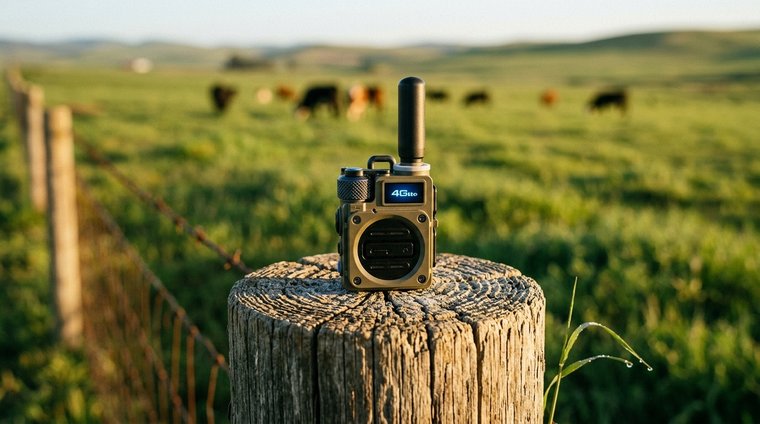
My husband and I run an 800-acre cattle operation in central Montana. It's been in his family for three generations. We don't have a crew. It's the two of us, a couple of dogs, and about 240 head of cattle spread across pastures that stretch from the main road down to a creek bed two and a half miles south.
For twelve years, our communication system has been yelling, hoping the other person is within earshot, or driving the truck across the property to say something that takes ten seconds. Cell phones are useless on about half the ranch. The lower pastures, the creek, the area near the tree line — zero bars. We looked into satellite phones once. $1,200 for the handset, $60 a month for the plan. We couldn't justify it for two people on a cattle ranch.
I found the TalkiesWorldWide while scrolling online late one evening. A 4G push-to-talk radio that claimed to work anywhere with cellular coverage. I almost kept scrolling. But the price caught my eye — $199 for a pair. That's less than one month of what a satellite phone would've cost us. I ordered the DUO.
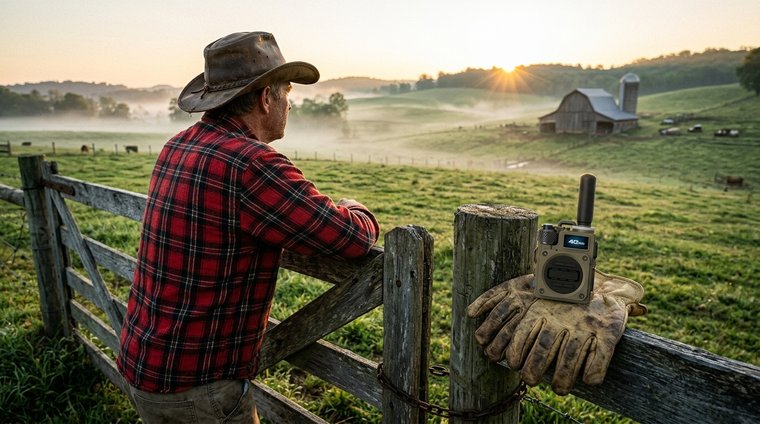
The dedicated external antenna is the difference — it picks up 4G signal where a phone shows nothing.
They arrived on a Thursday. I pulled them out of the box, and they were already set up. SIM pre-installed, no activation, no app to download. I turned one on, gave the other to my husband, and walked out the back door. He drove down to the lower pasture where we'd been moving cattle that morning — the spot where neither of our phones has ever had a signal.
I pressed the button standing by the creek where my phone hasn't worked in twelve years. He heard me from the barn. Clear as a phone call. I actually laughed out loud. Twelve years of driving back and forth across this property for a thirty-second conversation, and a $199 radio just solved it.
"I pressed the button standing by the creek where my phone hasn't worked in twelve years. He heard me from the barn. Clear as a phone call."
— Sarah Dalton, Cattle Rancher, MontanaHow it works where phones don't
The thing that makes this different from a regular walkie-talkie — and different from a phone — is the dedicated external antenna. Your phone has a tiny internal antenna that's also handling Wi-Fi, Bluetooth, GPS, and everything else. The TalkiesWorldWide has one job: push-to-talk over 4G. Its external antenna is built specifically for cellular reception. No Wi-Fi, no Bluetooth competing on the same chip. It picks up signal in places your phone simply can't.
Our property doesn't have zero coverage everywhere — there's 4G out here, just barely. My phone can't grab it down by the creek or in the dip near the south fence. But the TalkiesWorldWide can. That dedicated antenna is pulling in signal that a phone's tiny internal antenna misses entirely. For a ranch like ours, that's the whole game.
It runs on the 4G mobile network, not a radio frequency. That means no license, no range limit based on line of sight, and no interference from hills or buildings. It also means AES-256 encryption — the same standard banks use. I don't have state secrets to protect, but I like that nobody driving past with a scanner can listen in on where our livestock are or when we're away from the house.
Talkies has contacted us to let our readers know stock is available now. The DUO pack is $199 with free service included* for the first 2 years — no hidden fees, no subscription. Also available: Single ($149), TRIO ($279), QUAD ($359). Check availability while stock lasts.
Multi-day battery. Charge it on Sunday.
This is the detail that sold me more than anything else. I charged both radios on a Sunday evening. By Friday afternoon, they were still showing battery. Five full days of use without touching a charger. On a ranch, you don't want another device to babysit. You want something you can clip to your belt on Monday morning and forget about until the weekend.
We've settled into a routine now. Charge on Sunday night, use them all week. Morning feeding, afternoon fence checks, moving cattle between pastures — one press and we're talking. No fumbling with a phone, no waiting for a call to connect, no "can you hear me now" while walking in circles trying to find signal. Just push the button and talk.
What we actually use it for
The obvious one is livestock moves. When you're pushing cattle from one pasture to another, you need two people coordinating — one at the gate, one behind the herd. Before the TalkiesWorldWide, that meant a lot of arm waving and guesswork. Now I can tell him exactly when to open the gate, and he can tell me if any are breaking off to the left. Simple, instant, no delay.
Fence checks are the other big one. Our fence line runs for miles. If he finds a break, he used to have to drive all the way back to the barn to tell me what supplies to load up. Now he presses a button and says "Section 12, three posts down, bring the stretcher and wire." I'm already loading the truck before he's finished talking.
The small moments add up too. "I'm heading to town, need anything?" from the far pasture. "Calf looks off, come take a look" from the creek. "Gate's open on the north side" while I'm in the barn. These are ten-second conversations that used to cost us thirty minutes of driving. Multiply that by a dozen times a day and you start to understand why I'm writing about a two-way radio.
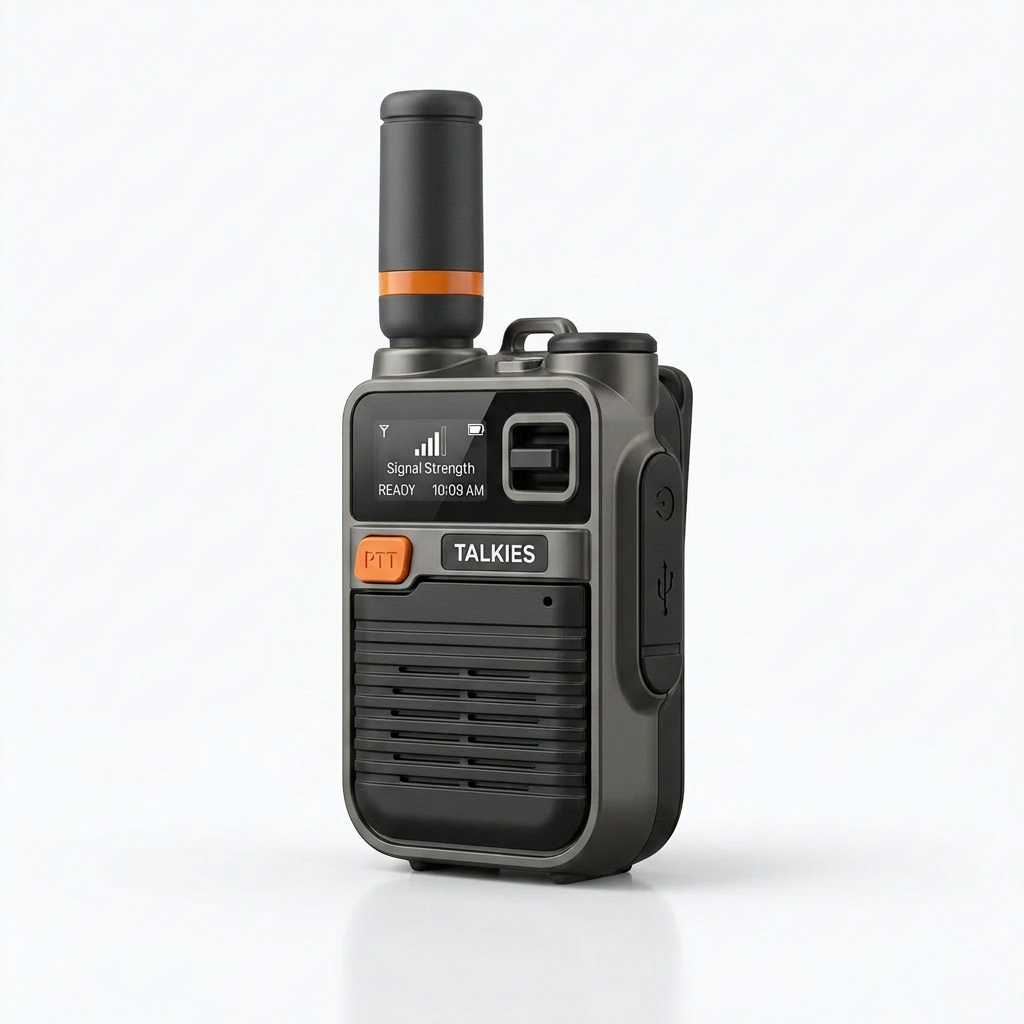
multi-day battery, AES-256 encryption, dedicated 4G antenna — built for people who work where phones don't.
What it replaced — and what it saved us
We retired the satellite phone idea permanently. That would've been $1,200 up front plus $720 a year in service fees — for a device that's slow, clunky, and takes 30 seconds to connect. The TalkiesWorldWide DUO was $199, one time. Free service included*. No monthly bill. No contract. It arrived ready to use.
It also replaced a pair of old UHF radios we'd been using near the barn. Those worked fine within about half a mile, then turned to static. They were useless for most of the property. The TalkiesWorldWide works everywhere the 4G signal reaches — which, thanks to that external antenna, turns out to be almost our entire 800 acres.
I'm not someone who gets excited about gadgets. I'm practical and I'm skeptical. If something sounds too good to be true, I usually assume it is. This radio is the exception. It does exactly what it says it does, and it does it for a price that makes you wonder why you didn't have one years ago.
Some notes:
- You don't need to set anything up — SIM is pre-installed, ready out of the box
- multi-day battery — charge it Sunday, use it all week without thinking about it
- Free service included* — no monthly bills, no subscription*
- Dedicated external antenna — picks up 4G where your phone shows zero bars
- Works on 4G cellular, not radio frequencies — no license needed, no line-of-sight limit
- AES-256 encryption — same standard used in banking and government
- Pricing: $149 single / $199 DUO / $279 TRIO / $359 QUAD
If you run a ranch, a farm, or any kind of rural property where cell phones are unreliable, this is the simplest upgrade you'll make all year. Two hundred dollars and a Sunday-night charge. That's it. That's the whole thing.
Talkies has contacted us to let our readers know stock is available now. The DUO pack is $199 with free service included* for the first 2 years — no hidden fees, no subscription. Also available: Single ($149), TRIO ($279), QUAD ($359). Check availability while stock lasts.